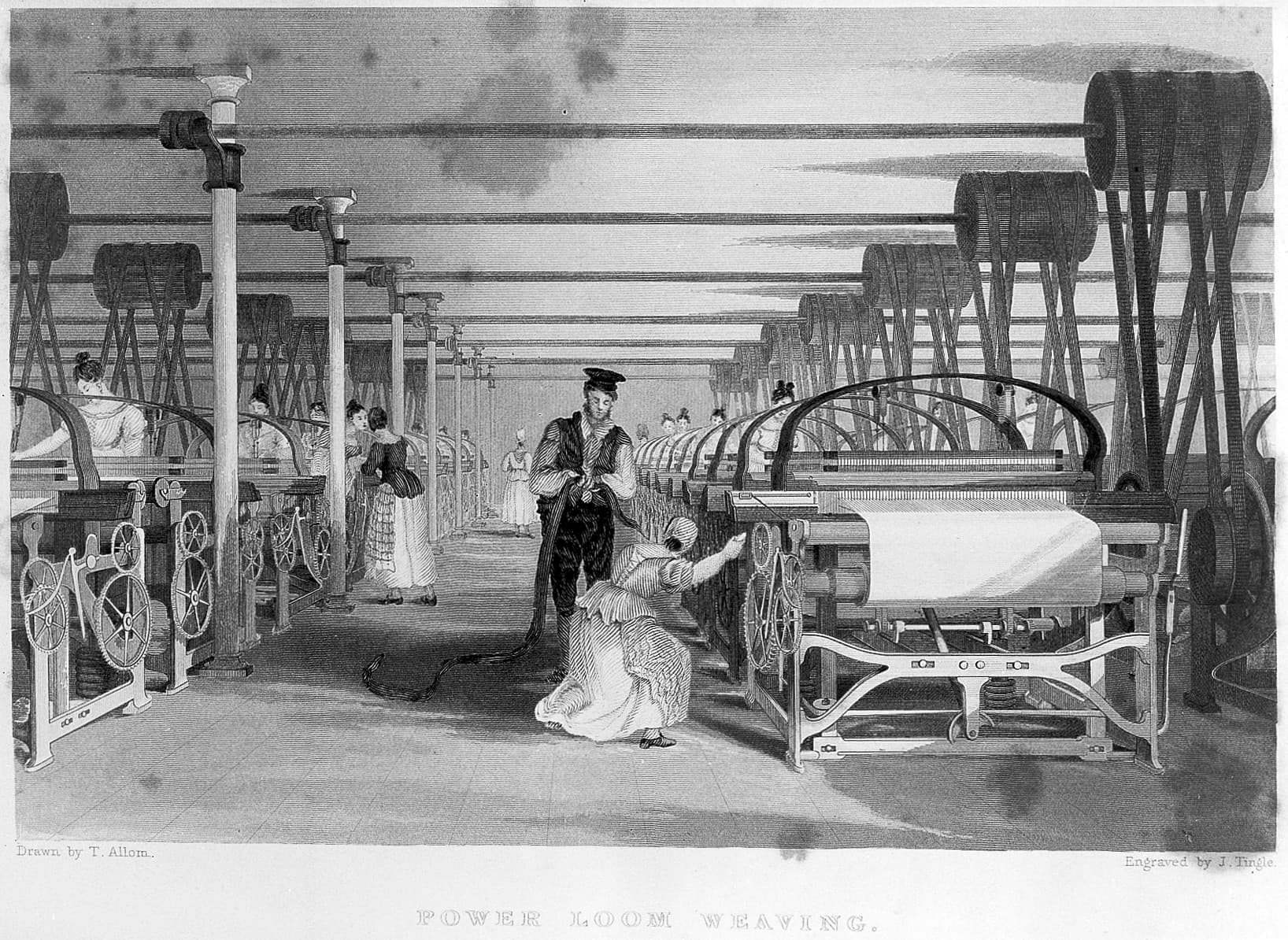
Ask the owner of any weaving company what their single most expensive asset is and the answer is always the same: the looms. A modern weaving mill has enormous capital tied up in machinery, and that machinery only earns money while it is running and producing saleable fabric. Every hour a loom sits idle — waiting for a beam, a repair, a decision — is money the mill has already spent and is now wasting. This is why running a weaving mill is fundamentally a game of loom utilisation, and why the mills that win are the ones that keep their looms running well, not just fast.
The weaving workflow, stage by stage
Fabric does not simply appear on a loom. The weaving process is a sequence of preparatory stages, each of which must be right before the next can proceed. It begins with warping, where thousands of individual warp yarns are wound in parallel onto a beam under uniform tension. Uneven tension here will haunt every metre of fabric later, so warping quality sets a ceiling on everything downstream.
The warp beam then goes through sizing, where the yarns are coated with a starch or synthetic size to strengthen them and reduce breakage during weaving. Sizing is unglamorous but decisive: an under-sized warp breaks constantly on the loom, and every break stops the machine and costs utilisation. Only after warping and sizing does the beam reach the loom itself, where the warp is interlaced with the weft (or filling) yarn inserted across the width to build the fabric. Finally, woven fabric goes to grey inspection, where defects are found and graded before the fabric moves on to dyeing and finishing.
Loom scheduling: the decision that governs the mill
The most consequential daily decision in a weaving mill is which fabric quality runs on which loom, and in what order. This is loom scheduling, and it is harder than it sounds because looms are not interchangeable. A given article may need a specific reed, a specific number of heald frames, a particular width, or a dobby or jacquard shedding mechanism. Assigning an order to a loom that cannot run it, or that needs a long changeover to run it, quietly destroys capacity.
Good scheduling minimises changeovers by grouping similar articles, sequences beams so that a loom never runs empty waiting for its next warp, and balances load across the shed so that no set of looms is a bottleneck while others idle. Poor scheduling — the kind done on a whiteboard and rebuilt every morning — produces the opposite: gaps between beams, avoidable changeovers, and looms that stop because nobody planned the next job in time. Since utilisation is the whole game, scheduling is not a clerical task; it is the lever that most directly controls the mill's output and margin.
Beam and warp management
Behind every running loom is a supply chain of beams that must arrive in the right sequence at the right time. Beam and warp management is the discipline of tracking each warp beam from the warping frame, through sizing, to the loom on which it will be mounted, and knowing how much warp remains on a running beam so the next one is prepared before the current one runs out. A loom that finishes its beam with no successor ready is an avoidable stoppage — one of the most common and most invisible causes of lost utilisation. Treating beams as tracked, scheduled objects rather than things that turn up when they turn up is what keeps a loom fed continuously.
Measuring loom efficiency honestly
You cannot manage what you do not measure, and in weaving the number that matters is loom efficiency — actual output as a percentage of the theoretical maximum if the loom ran continuously at rated speed with no stops. Real efficiency is dragged down by warp and weft breaks, changeovers, mechanical downtime, and waiting for beams or decisions. A mill that believes its looms run at ninety-plus percent and has never measured stop-by-stop is almost always wrong. Capturing why each loom stopped — and for how long — turns a vague sense that things are fine into a ranked list of what is actually costing production, which is the only honest basis for improvement.
Quality: the 4-point system
A weaving mill is not paid for metres woven; it is paid for saleable metres. The industry standard for grading fabric is the 4-point system, in which each defect found during grey inspection is assigned penalty points by its length or severity, points are totalled per unit of fabric, and a roll passes or fails against an agreed points-per-100-square-metre threshold. The value of the 4-point system is that it makes quality objective and comparable — buyer to buyer, loom to loom, weaver to weaver. Recording defects this way also reveals patterns: a particular loom or a particular warp lot throwing repeated defects points straight at a mechanical or preparatory root cause that would otherwise stay hidden.
Where the money leaks — and how ERP plugs it
Put the pieces together and the leaks in a weaving mill are consistent: looms idle between beams, avoidable changeovers from poor sequencing, stoppages nobody quantified, and quality problems traced too late to their source. Every one of these is an information problem before it is a mechanical one. The mill is not short of capacity; it is short of visibility into how its capacity is actually being used.
This is where a textile ERP changes the economics of a weaving unit. It schedules looms against their real capabilities and beam availability, so orders land on machines that can run them with minimum changeover. It manages beam and warp flow so the next beam is prepared before the current one runs out, closing the gaps that idle looms. It captures loom stops and efficiency by machine and shift, turning downtime into a ranked, addressable list. And it records 4-point inspection against the loom and warp lot, so recurring defects lead back to their cause. Together, purpose-built production planning inside a textile ERP does the one thing a weaving mill needs above all else — it keeps expensive looms running on the right work, which is where every rupee of weaving margin is made.
None of this replaces skilled weavers or good maintenance; it makes their work visible and their decisions data-driven. The mills pulling ahead in a competitive weaving market are not the ones with the newest looms. They are the ones that squeeze the most saleable fabric out of the looms they already own — and that is a management and information advantage far more than a machinery one.
Frequently Asked Questions
What are the main stages of the weaving process?
Warping (winding thousands of warp yarns in parallel onto a beam under uniform tension), sizing (coating the warp to strengthen it and reduce breakage), weaving (interlacing warp with weft on the loom), and grey inspection (grading defects before dyeing and finishing). Each stage must be right before the next can proceed — poor warping or sizing degrades everything downstream.
What is loom scheduling and why is it important?
Loom scheduling decides which fabric quality runs on which loom and in what order. Looms are not interchangeable — an article may need a specific reed, heald frames, width, or shedding mechanism. Good scheduling minimises changeovers, sequences beams so looms never run empty, and balances load, directly controlling utilisation, which is the main driver of a weaving mill's output and margin.
What is the 4-point system in fabric inspection?
The 4-point system grades woven fabric by assigning penalty points to each defect based on its length or severity, totalling points per unit of fabric, and passing or failing rolls against an agreed points-per-100-square-metre threshold. It makes quality objective and comparable across looms, weavers, and buyers, and reveals defect patterns that point to root causes.
How does ERP raise loom utilisation?
It schedules orders onto looms that can run them with minimum changeover, manages beam and warp flow so the next beam is ready before the current one runs out, captures loom stops and efficiency by machine and shift to rank the real causes of lost production, and ties 4-point inspection to the loom and warp lot so recurring defects lead back to their source.
Vastra ERP Editorial Team
Textile Technology Experts
Our editorial team brings decades of combined experience in textile manufacturing, supply chain management, and enterprise technology. We publish in-depth guides, industry analysis, and practical insights for textile professionals worldwide.