Almost every cotton garment in the world begins with spinning, and the majority of the world's yarn is still made by ring spinning — a technology over 150 years old that no alternative has fully displaced for fine, strong yarns. For a spinning mill, ring spinning is the whole business: the quality of the yarn and the cost of making it decide whether the mill makes money. This guide explains how ring spinning works, how it compares to the main alternative, and where a mill turns spinning into a measured, managed operation rather than a black box.
What ring spinning is
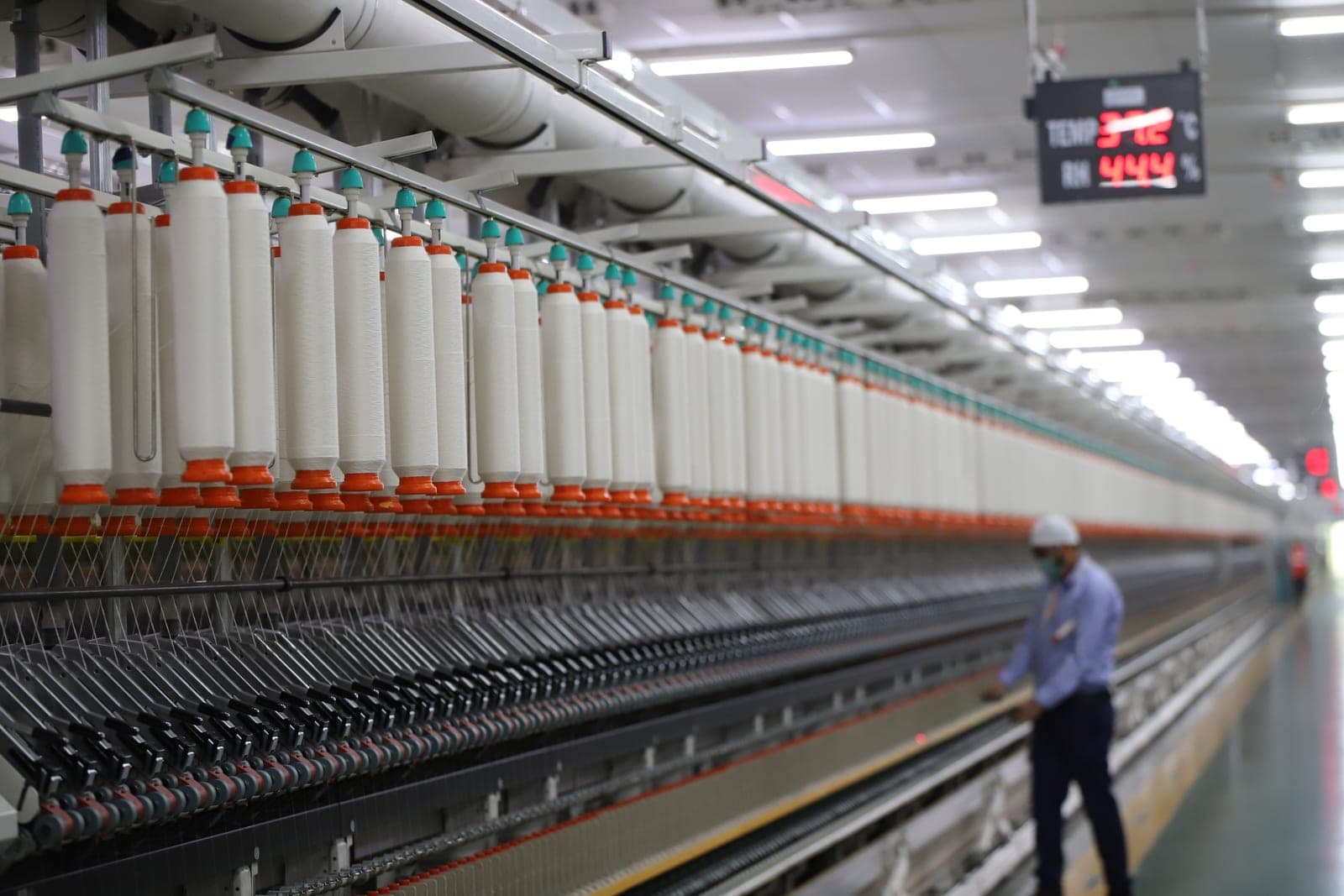
Ring spinning is the final stage in a sequence that turns raw cotton into yarn. After the fibre is opened, cleaned, carded and drawn into a soft rope called roving, the ring frame does two things at once: it drafts the roving thinner to the required fineness, and it inserts twist to bind the fibres into a continuous, strong yarn, winding it onto a bobbin. The name comes from the ring-and-traveller mechanism that inserts the twist as the yarn winds. It is prized because it produces strong, fine, high-quality yarn suitable for the widest range of end uses.
Ring spinning vs open-end spinning
The main alternative is open-end (rotor) spinning, which is faster and cheaper but produces a bulkier, slightly weaker yarn generally limited to coarser counts. The trade-off is straightforward: ring spinning wins on quality and fineness and the range of yarns it can make; open-end wins on speed and cost for coarse yarns like those in denim and towels. Many mills run both, choosing by the yarn count and quality the order needs. Knowing which process suits which order is part of running a mill profitably.
Where quality and cost are won or lost
Ring spinning quality comes down to consistency — of the fibre going in, and of the process itself. The count must be uniform (variation shows up as thick and thin places), the twist must be right (too little and the yarn is weak, too much and it is harsh and costs productivity), and end breakages must be controlled (each break is lost production and a potential fault). On cost, the mill watches conversion cost per kilo, machine productivity and waste. None of these can be managed if they are not measured — which is the gap in mills that run on shift registers and memory.
How ERP turns spinning into a measured operation
A spinning ERP captures the mill as data. Production is recorded by frame, shift and count, so output and productivity are visible rather than estimated. Quality parameters — count, twist, strength, unevenness — are held against lots, so a problem batch is traceable and a drifting frame is spotted. Consumption and waste are captured, so conversion cost per kilo is real. And orders are planned against real capacity by count, so the mill commits to what it can actually spin. This is the production planning and quality discipline of the textile ERP platform, configured for a spinning mill.
Where AI helps
AI's realistic contribution in spinning is pattern-finding and prediction on captured data. With production and quality recorded across frames and shifts, AI can flag the frame that consistently produces higher unevenness, or the correlation between a raw-cotton lot and downstream breakages, faster than manual analysis. Where machines carry sensors, AI predictive maintenance can flag a frame heading for a fault before it stops. And document AI reads incoming yarn orders and cotton purchase documents into the system. The spinning itself remains a mechanical process run by skilled people; AI makes its data actionable.
Ring spinning is old technology, but running it profitably is a modern data problem: measure the count, the twist, the breakages, the cost per kilo, and manage what you measure. A mill that spins on registers and memory cannot see where its quality and margin leak. If yours does, that visibility is the first thing worth building, and you can see how a spinning operation is tracked with your own counts and frames.
Frequently Asked Questions
What is ring spinning?
Ring spinning is the final stage of turning cotton into yarn. After the fibre is opened, cleaned, carded and drawn into a soft rope (roving), the ring frame drafts the roving to the required fineness and inserts twist to bind the fibres into a strong continuous yarn, winding it onto a bobbin via a ring-and-traveller mechanism. It produces strong, fine, high-quality yarn for the widest range of uses.
What is the difference between ring and open-end spinning?
Ring spinning produces strong, fine, high-quality yarn across the widest range of counts but is slower. Open-end (rotor) spinning is faster and cheaper but produces a bulkier, slightly weaker yarn generally limited to coarser counts, as used in denim and towels. Many mills run both and choose by the yarn count and quality the order needs.
How does ERP help a spinning mill?
A spinning ERP records production by frame, shift and count so output and productivity are visible; holds quality parameters (count, twist, strength, unevenness) against lots so problems are traceable; captures consumption and waste so conversion cost per kilo is real; and plans orders against real capacity by count. AI adds pattern-finding on that data and predictive maintenance where machines are instrumented.
Vastra ERP Editorial Team
Textile Technology Experts
Our editorial team brings decades of combined experience in textile manufacturing, supply chain management, and enterprise technology. We publish in-depth guides, industry analysis, and practical insights for textile professionals worldwide.