Textile printing is where a plain fabric becomes a product with a design, and it is also where a surprising amount of a processing house's money is made or lost. The method chosen — screen, rotary, digital or block — sets the minimum viable run, the per-metre cost, the colour accuracy and the kinds of defect you will fight. Choosing the wrong method for an order, or losing track of colour and consumption across a run, quietly erodes margin. This guide explains the main textile printing methods and where a production system keeps each run under control.
Screen printing
Flat-bed and hand screen printing pushes ink through a stencilled mesh, one screen per colour. It is versatile and cheap to set up for short and medium runs, which is why it remains common in India for saris, dress materials and made-ups. Its limits are speed and registration: every additional colour is another screen and another chance for misalignment, and long runs are slow. Screen printing on fabric remains the entry point for most small processing houses — but a design with six colours needs six screens, each aligned precisely.
Rotary printing
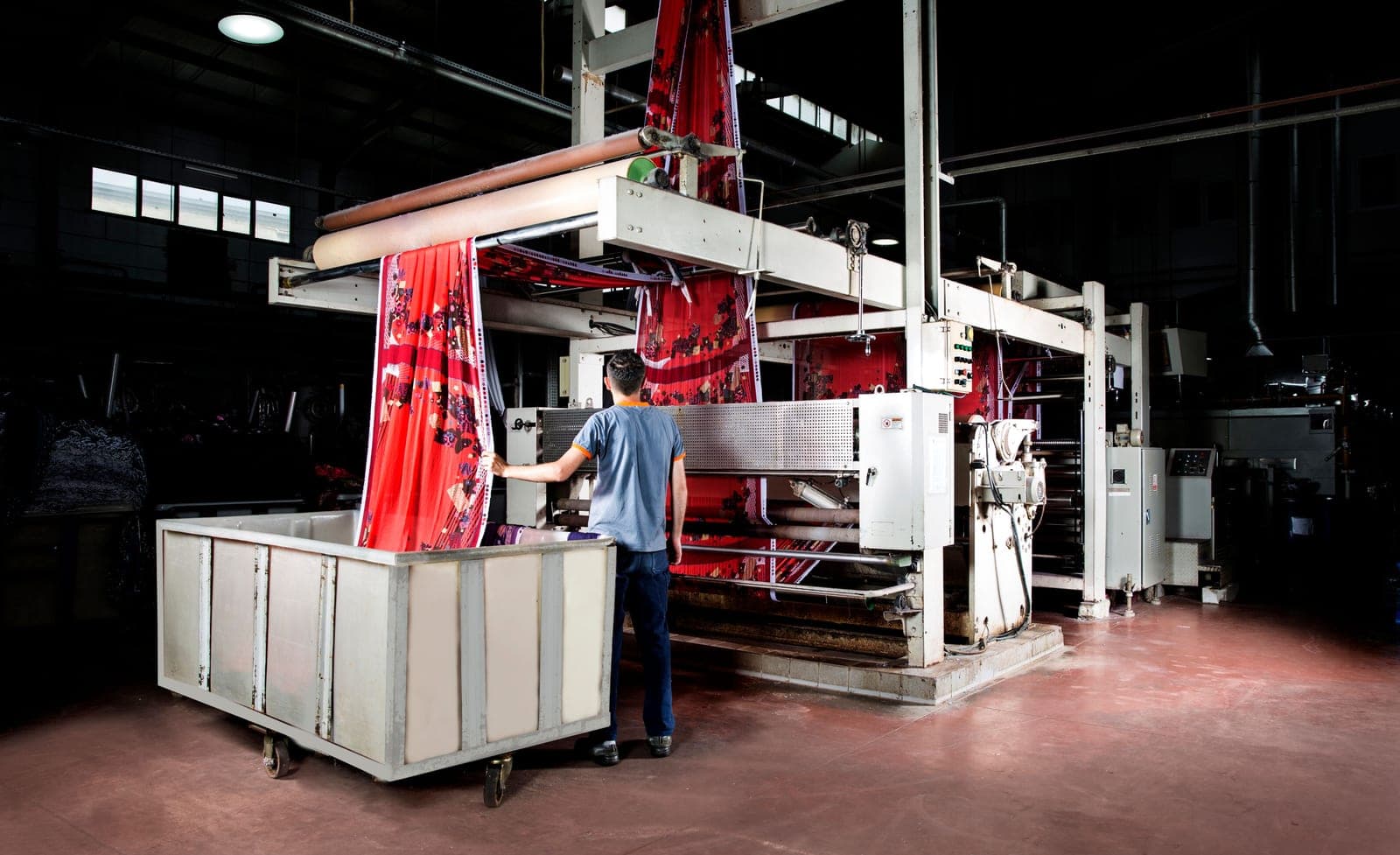
Rotary screen printing wraps the stencil around a cylinder that prints continuously as the fabric runs beneath it. This is the workhorse of high-volume continuous printing — fast, consistent, and economical once the run is long enough to justify engraving the cylinders. The trade-off is exactly that setup cost: rotary is wrong for short runs and design changes, and right for bulk repeat business.
Digital printing
Digital textile printing jets ink directly onto fabric from a print head, with no screens or cylinders at all. That removes the setup cost entirely, which makes it ideal for short runs, samples, and highly detailed or photographic designs with unlimited colours. Its limits are speed and ink cost per metre at high volumes, though both keep improving. For a business doing many small, varied orders, digital has reshaped the economics — the question is no longer 'can we print this design' but 'is the run long enough that rotary beats digital'.
Block printing and transfer printing
Block printing — carved wooden blocks stamped by hand — is the traditional Indian craft method, valued for hand-made appeal rather than volume. Transfer printing moves a design from pre-printed paper onto fabric under heat, common for polyester. Both occupy specific niches: block for artisanal value, transfer for cheap synthetic prints.
The operational problem: colour, consumption and cost per run
Whatever the method, every print run raises the same three questions, and they are where processing houses lose money. First, **colour consistency** — does batch two match batch one, and does either match the approved shade card? Second, **consumption** — how much greige, ink and chemical did this run actually use against what was estimated? Third, **cost and margin** — what did this specific run cost, and did the job make money? When these live in a printing master's memory and a few registers, the answers arrive late and approximate.
How ERP keeps every print run under control
A textile production system ties each print run to its order, its recipe and its stock. The design and colourway are held against the style; greige, ink and chemical are issued and reconciled against the run so consumption is measured, not guessed; and the actual cost rolls up per run so margin is visible before the next order is quoted. Rejections and reprints are captured against the run rather than absorbed silently. That is the difference between a printing operation that knows its numbers and one that only finds out at month-end. The mechanics sit in the production planning and quality control modules of the textile ERP platform.
Where AI adds to printing
The emerging layer is AI. Computer-vision inspection can scan printed fabric as it runs and flag registration errors, colour drift or print defects faster and more consistently than the human eye at speed — catching a mis-registered run before hundreds of metres are wasted. AI shade-matching can compare a printed sample against the approved standard and quantify the difference instead of relying on a judgement call under variable light. And AI can read a buyer's print order or artwork brief and pull the colours, repeat and placement into the job automatically. None of this replaces the printing master's skill; it gives that skill data to act on sooner. Framed honestly, AI-powered ERP does not print better — it wastes less, by seeing problems in the run while there is still time to fix them.
Choosing the right printing method is a design and economics decision; running it profitably is a data decision. If your print runs are costed by feel and colour is signed off by eye, that is where the first improvement usually hides — and you can see how a run is tracked end to end with your own fabrics.
Frequently Asked Questions
What are the main methods of textile printing?
The main methods are screen printing (flat-bed or rotary, one stencil per colour), digital printing (ink jetted directly onto fabric, no screens), block printing (hand-stamped wooden blocks, traditional and artisanal), and transfer printing (design moved from paper under heat, common for polyester). Each has a different setup cost, minimum run length and colour capability.
Which textile printing method is cheapest?
It depends on run length. For short runs and samples, digital printing is usually cheapest because there is no screen or cylinder setup cost. For long, repeat bulk runs, rotary printing becomes cheapest per metre once the setup cost is spread across enough fabric. Flat-bed screen printing sits in between for short-to-medium runs.
How does ERP help with textile printing?
A textile production system ties each print run to its order, design and recipe: greige, ink and chemicals are issued and reconciled against the run so consumption is measured, actual cost rolls up per run so margin is visible, and rejections/reprints are captured rather than absorbed silently. AI adds computer-vision defect detection and shade-matching on top.
Vastra ERP Editorial Team
Textile Technology Experts
Our editorial team brings decades of combined experience in textile manufacturing, supply chain management, and enterprise technology. We publish in-depth guides, industry analysis, and practical insights for textile professionals worldwide.