Weaving is one of the oldest crafts humans have, and at heart it is simple: interlace two sets of yarn at right angles and you have fabric. But between a cone of yarn and a running loom lies a sequence of preparation steps that most people never see and that decide whether the weaving actually runs. A mill that understands the whole weaving process — not just the loom — is one that weaves efficiently; a mill that treats everything before the loom as an afterthought fights breakages and stoppages all day. This guide walks the process from yarn to fabric.
The two sets of yarn
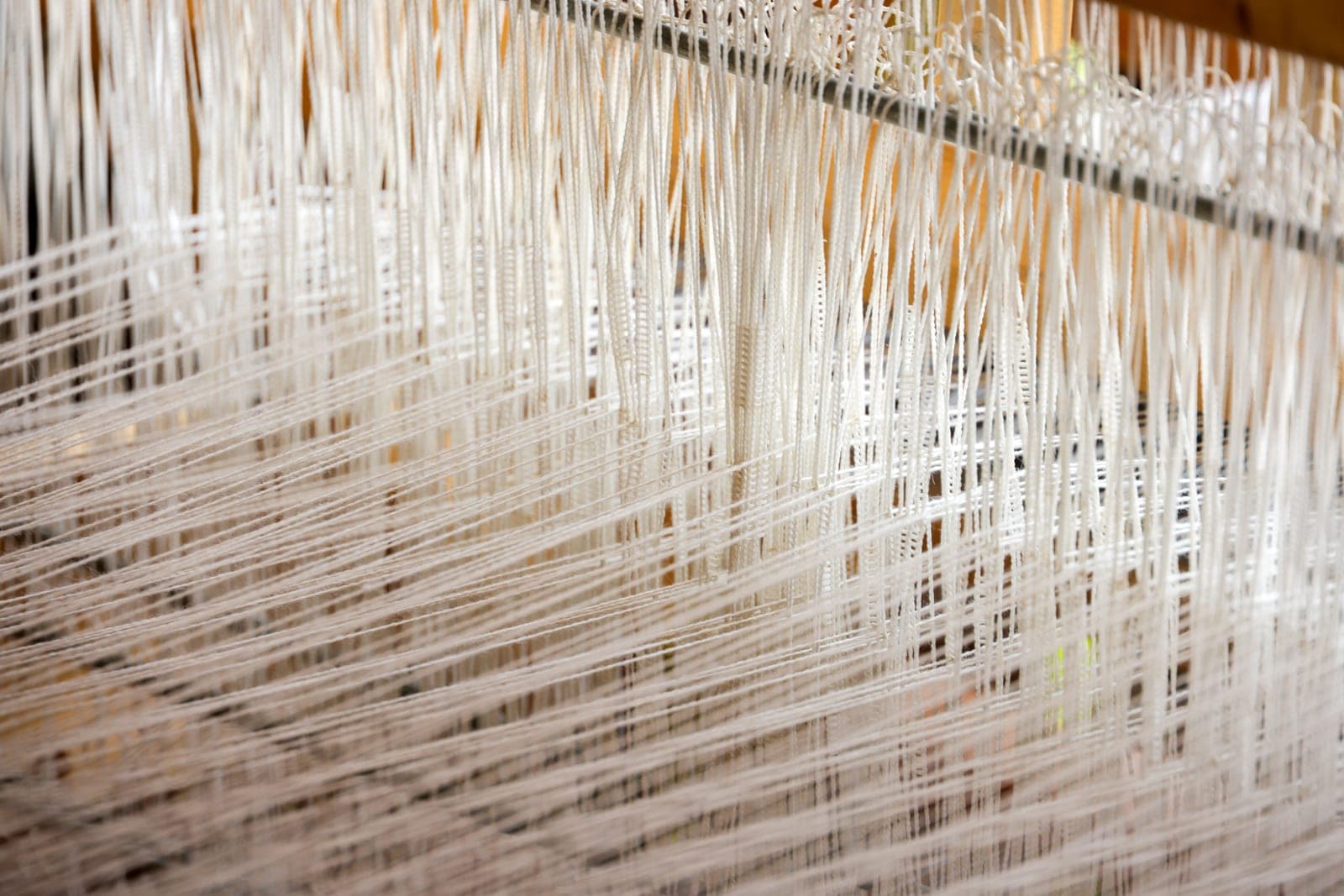
Every woven fabric has warp yarns (running lengthwise, held under tension on the loom) and weft yarns (running across, inserted one pick at a time). The warp is the demanding one: hundreds or thousands of ends must be arranged in parallel, at even tension, strong enough to withstand the repeated stress of weaving. Almost all the preparation work is about getting the warp ready; the weft is comparatively simple.
Warp preparation: warping, sizing, drawing-in
**Warping** winds many yarn ends from a creel onto a beam in parallel, at uniform tension — the foundation of an even warp. **Sizing** coats the warp yarns with a starch or synthetic film to make them stronger and smoother so they survive the abrasion of weaving; it is one of the most important steps for weaving efficiency, because poorly sized warp breaks constantly. **Drawing-in (or tying-in)** threads each warp end through the heddles and reed in the correct order, which sets up the weave pattern. Only after all this is the loom ready to weave.
Weaving on the loom
On the loom, weaving repeats three motions: shedding (raising some warp ends and lowering others to open a gap), picking (inserting the weft through the gap), and beating-up (pushing the new weft firmly against the woven cloth). Modern looms insert weft by air-jet, water-jet, rapier or projectile instead of a traditional shuttle, running far faster. The type of weave — plain, twill, satin — is set by which warp ends are raised on each pick. Fabric builds pick by pick and winds onto the cloth beam.
Where weaving efficiency is won or lost
A mill's weaving cost is dominated by loom efficiency — the proportion of time looms actually run versus stop. Stops come from warp and weft breaks, which trace back to yarn quality and warp preparation, and from changeovers. This is why the invisible preparation stages matter so much commercially: good warping and sizing mean fewer breaks, more running time, and lower cost per metre. A mill that measures loom efficiency and traces stops to their cause can improve it; one that does not simply accepts whatever the looms deliver.
How ERP manages weaving production
A weaving ERP connects preparation, looms and orders. Beams and their specifications are tracked from warping through to the loom; production is recorded by loom and shift, so loom efficiency and output are measured rather than estimated; stops and their causes are captured, so the recurring problem (a bad sizing batch, a particular yarn lot) becomes visible. Orders are planned against loom capability and capacity, and production planning sequences work to cut changeovers. It is the manufacturing backbone of the textile ERP platform, configured for weaving.
Weaving is simple in principle and demanding in practice, and most of the demand lives in the preparation the loom depends on. A mill that manages the whole process — warping, sizing, drawing-in and weaving — as measured, connected stages weaves more efficiently than one that watches only the loom. If your loom efficiency is a mystery and stops are never traced, that is where cost hides, and you can see how weaving production is tracked with your own looms and beams.
Frequently Asked Questions
What are the stages of the weaving process?
Weaving runs from yarn to fabric through warp preparation and weaving. Warp preparation is warping (winding many ends onto a beam at even tension), sizing (coating warp yarns to strengthen them for weaving), and drawing-in (threading each end through the heddles and reed to set the pattern). Then the loom weaves by repeating shedding, picking (weft insertion) and beating-up, building fabric pick by pick.
Why is warp preparation so important in weaving?
Because loom efficiency — the proportion of time looms actually run — dominates weaving cost, and most stops come from warp breaks that trace back to yarn quality and warp preparation. Good warping and sizing mean fewer breaks, more running time and lower cost per metre. The invisible preparation stages therefore decide how profitably the visible loom runs.
How does ERP help with weaving production?
A weaving ERP tracks beams and specifications from warping to the loom, records production by loom and shift so loom efficiency is measured, and captures stops and their causes so recurring problems (a bad sizing batch, a particular yarn lot) become visible. It plans orders against loom capability and capacity and sequences work to cut changeovers.
Vastra ERP Editorial Team
Textile Technology Experts
Our editorial team brings decades of combined experience in textile manufacturing, supply chain management, and enterprise technology. We publish in-depth guides, industry analysis, and practical insights for textile professionals worldwide.